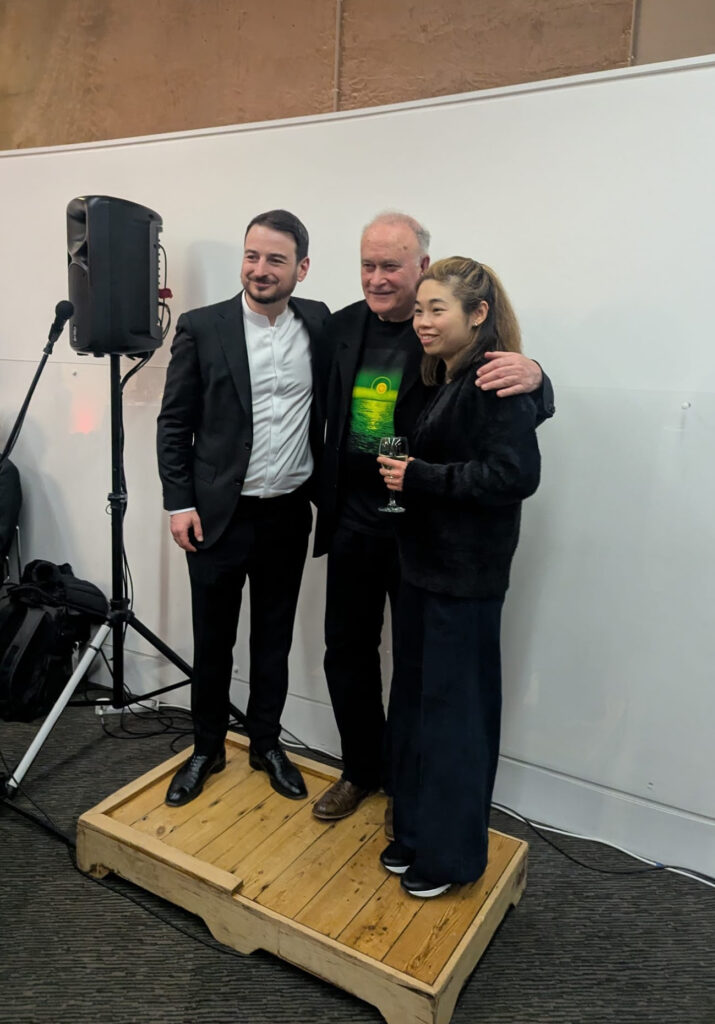
My Oboe Concerto, commissioned by the LSO, had its first performance at the Barbican on February 8. The LSO gave a reception after the concert and here I am with Olivier Stankiewicz (Oboe) and Elim Chan (Conductor). Their performance couldn’t have been better.
Here’s the programme note, which was written by Tim Rutherford-Johnson:
When asked by the LSO – an orchestra he has known for thirty-five years – to write a concerto for one of its players, Colin Matthews had little hesitation before deciding to write for its principal oboist since 2015, Olivier Stankiewicz. The choice was not that difficult: Matthews has written for the oboe many times before, including two relatively early oboe quartets. Stankiewicz – whose playing Matthews describes as ‘wonderful’ – has the second of these already in his repertoire; the composer notes that he has also been ‘an exceptionally helpful representative of the orchestra’ during its annual Panufnik Workshops scheme for young composers.
The oboe is one of the orchestra’s most flexible instruments, equally adept at graceful elegance and almost clownish agility. With both a strong low register and a piercing high, it is well capable, despite its size, of holding its own against all but the largest orchestra. (Matthews reins his in only a little, with a modest percussion section and sparing use of the brass.) Here, it is cast as an independent spirit, set somewhat apart from its orchestral colleagues. There is little in Matthews’ concerto of the languorous pastoralism of the Vaughan Williams, or the gossipy nostalgia of the Strauss. Instead, Stankiewicz is thrown into the teeth of a storm that, while it ebbs and flows, never fully relents.
Although played without a break, the seventeen-minute concerto falls into perhaps five clear sections that roughly follow the course of a traditional concerto. A tempestuous first section establishes the terms of the debate: while the orchestra continually shape-shifts and reforms, the oboe persists on its own path, seeking handholds in flurries, syncopation and piercing held notes – all ways to maintain its identity in the face of its magmatic companion. A more flowing second section is heralded by a brief duet with the cor anglais – a rare moment of agreement between orchestra and soloist – and uneasily lolloping orchestral rhythms. This is followed by a slow third section in which the oboe’s lyrical qualities are for once allowed to shine through, before a jagged scherzo casts soloist and orchestra into an almost hocketing game of call and response, in which neither side seems ready to relinquish its position. The closing pages of the work reprise several of the concerto’s earlier moments before ending abruptly, as if still in the midst of negotiations.